Showing posts with label Oolong. Show all posts

Saturday, August 11, 2012

A first time look at Ginseng oolong

I have never really looked into ginseng oolong before because I had just lumped it into the category of flavored teas, which usually I don't purchase to drink. If someone buys a flavored tea for me I will enjoy it as such, but I never quite wanted this blog to feature flavored teas. I have been lacking in posts due to the limited number of samples I have been receiving, although that will change this month! I have gained quite a collection and wish to show them off to you all!

This tea was interesting from the get go. The pearled leaves, oolong from DongDing mountain in Taiwan, are coated in what almost looks like a ginseng paste. They are a dull, hunter green color and carry the smell of ginseng, strawberry, hibiscus and greenery. The scents aren't all that strong and don't lead me right away to assume the tea was flavored with anything!

The taste really was a delightful surprise! It is lightly flavorful and reminiscent of a roasted oolong with a layer of sweet fruit! It is balanced great and has a delicate mouthfeel.

Brown sugar, peaches, toasted nuts and strawberry come to mind as I sip and savor this first encounter. It struck me afterwards that it reminded me of a sweet, flakey pie crust! I didn't know that the ginseng would be so subtle and yet add so much to a tea.

This tea would be wonderful iced and really appeal to a wide audience! I couldn't drink this every day, but every now and again this tea is really a good treat!
Thank you to Teavivre for the sample! Every time I open one of their teas I am really starting to enjoy the quality and wonderful customer service this company offers! Their prices are nothing to overlook either! Definitely recommend this company for some good teas and good deals!

Monday, April 16, 2012

JinXuan "Milk" Oolong Tea

I have encountered several JinXuan teas, more notably code-named "Milk" or "Silk" or "Creamy" oolongs.
There is little promise of authenticity among this style of tea, as they have been overwhelmingly popular on the global market, and so to keep up with demand, ways of physically altering, flavoring, or scenting the teas has become common practice. I have already had one "Milk" oolong on this blog so far, so let us see how this subject fairs in the tumultuous tasting test.

Gratitude to Teavivre for this sample.


There were several of these red packages inside the large package, basically single serve portions of tea.
I would have liked to see them vacuum sealed, but the other option that this could have went through was a nitro-flush, which would have been acceptable as well. I just know that tea does not stay fresh in small quantities, even when sealed.


The leaves look good, and smell good. They smell just creamy enough, but I can still tell that this is an oolong because of the light, floral notes coming off of it.


The liquor is very clear and the only particles I can see are down from the leaves. No foreign morsels floating around and interfering with my enjoyment of this tea.

The smell and taste of the liquor is sufficient, but a bit plain. There are subtle creamy/buttery notes that are expected with JinXuan teas, but also a very simple "oolong" flavor that green oolongs tend to have. This tea is a bit sweeter than most though, but that is most likely just due to the cultivar.


The leaves, as seen below, are healthy enough and look just as honest. I am in no way disappointed by this tea session, other than the simple fact that this was not a prime, top quality JinXuan. It should have had a much more dynamic in flavor. This tea was flat, but at least it was not lifeless.

In my opinion, this would only be a good buy because of the price, not the taste. This is relatively inexpensive and would probably get you better tea for less money than you could potentially spend elsewhere.


 What I find remarkable is that Teavivre sells both a flavored JinXuan and an unflavored JinXuan. It would be interesting to compare the two to see the difference. Perhaps this is an authentic JinXuan, but just sub-par compared to the province's other productions.


~Billy

Wednesday, March 28, 2012

2011 BaXian "Eight Immortals"


Greg of NorbuTea kindly gifted me this sample along with a few teas I purchased.
What I didn't know about this tea was that there was only 4.4kg produced, and Greg had 2kg of it.

Man do I feel privileged!


I must say, this tea was a sight for sore eyes! The leaves are beautiful, both in shape and color. I had been wanting DanCong for a while and this tea definitely sufficed!

The aroma was strong and marvelous!
Very floral with notes of raw honey, melon, and fresh spring water.

This tea smells like it was just harvested and produced! DanCongs have a way with enchanting aromas.

When I put the tea into a warmed clay gaiwan, the aroma of the dry leaves was even stronger, and a nutty almond fragrance appeared.

If I had to stop here with this tea, I would still say it was a successful tea session.
I felt like I had already tasted it.

Fortunately for me and you, I had no restrictions and so I poured the water and watched the leaves swirl.

The resulting liquor was perfectly balanced.


It had the aroma of spring flowers, and a sweet, smooth taste that reminded me of tropical fruits.
Astringency lightly bit the back of my tongue and made me want more...more...more...

I was impressed to say the least!


This tea is stellar.
Its well produced and was obviously cared for at each point in its existence and production.

The leaves make a dancing display like I have never seen.

The flavor is crisp, fresh, and ripe.

I only have a few more precious leaves left and I will brew them with care.


~billy

Thursday, January 26, 2012

DongDing Charcoal Roasted

The wonderful folks at ChanTeas graciously sent me a couple samples of tea! This is one I was quite excited to try.

As all TungTing (DongDing) teas I have had, the leaves are pretty small and tightly compressed. They look great, and smell fantastic.
There is a surprisingly green smell, like fresh grass, coming off the leaves. A woody background is present, as well as the lingering smell of stone fruit!

The charcoal scent really presents itself in the wet leaf as it cools off after the initial rinse. Authentic? I think yes. I am just not sure on the year...(anyone care to fill me in?)

It is very relaxing and warming in its presentation and characteristics. This is exactly what I need at the moment. I need to bring myself back from stress and the hustle and bustle of everyday life for a college student and business owner.

The aroma of the liquor is enticing. It seems sweet, yet balanced.
Stone fruit, vanilla, roast, and a light scent of hazelnut complete the aromatic spectrum of this tea.

As for the flavor,
peaches.

Lots of peaches.

A fresh, juicy peach.

Absolutely astounding that a tea can be this fruity. I find it wonderfully appealing!

The tea is smooth in texture, and does not have a heavy roasted flavor. A roast, to me, is meant to compliment and enhance the existing flavors. The roast on this tea is a great example of how to execute this properly.
The finish is clean.
Just a ghostly hint of the tea's character.

The sweet, peachy notes of the tea slowly recede as the session goes on.

Fantastic tea.

And now, off to sample some coffee for business!
Perhaps a new alias is on the horizon...Sir William of the Bean...?

We shall see!

~Billy

Saturday, October 15, 2011

15 Year Old (?) Dong Ding

As you can see by the pictures below, my tea ware and tea tray have seen much more use lately. I am glad that some stains are accumulating, even with after session rinses. It shows some love and memorable use.

In my pot lately, pu'erh has seen much action (this one specifically). Also, roasted and aged oolongs, as the weather is starting to shift from warm Autumn, to brisk Autumn.
I find that aged and roasted oolongs (yesterday's tea) are perfect for afternoon Autumn weather here in Indiana.

The stains give these tea utensils character beyond what their maker put into them.
Stains make tea ware personal.

I had the privilege to be hosted in Dallas last weekend for a wonderful tea event put on by the owners of the Cultured Cup. If you are ever in Dallas, call them up and schedule a tasting or just a visit. They are some of the most wonderful people I have met in the industry.

Also, I was so fortunate enough to have a tasting session with Greg, the owner of Norbu Tea (a company who has been on my radar for quite some time). We tasted some wonderful aged pu'erhs, a Liu Bao basket tea and an aged Fo Shou.

I was also fortunate enough to be gifted a sample of a 15 year old Dong Ding (or so labeled) from Floating Leaves.

It is wonderful to come back to more periodic gongfu sessions with such outstanding teas.

The dry leaves have the smell of roasted barley, brown sugar, and vanilla. I find that aged oolongs often smell much sweeter than they actually are, as it would be a dessert tea if it really did taste as sweet as it smelled!

Once the water is poured off the leaves for the rinse, I can immediately smell notes of strong coffee off of the damp leaves.

After the first infusion is poured into the faircup, I plunge my nose into it to take in the scents. There is strong hints of coffee, dark chocolate, vanilla and coconut.
This tea is warming for the soul and a great taste for a whetted appetite.

This tea is savory rather than sweet in flavor, as the scents would falsely suggest.
There is much resemblance to wood and roasted nuts. A light charcoal note lingers as the tea is consumed.
As the infusions continue, a light astringency is revealed, which brings up snapshots of its youth. Quite the session.


~billy

Thursday, August 11, 2011

White Oolong

White Oolong...

This tea does not quite resemble a white tea, or an oolong tea.
Read more about this contradiction at the Norbu Tea website.

The dry leaf is quite extraordinary; the leaves look frosted and outlined in faint white. The leaves are well pearled and have a wonderful waxy sheen to them.

In trying to describe this tea in a way one could understand, I ran into a few instances of writers block, and tasting memory block (if there is such a thing!).

The aroma of the dry leaf can be summed up in a few different scents:
Sweet bread, cream and raw stevia.
There is also a very mildly vegetal hint in the mixture of aromas.

The leaves after the initial rinse had a plain smell that was simply milky sweet.
In several ways, this tea reminded me of a quality baozhong.

As the tea brewed, I took to thinking.
This tea was unlike any other I have experienced thus far. To even say this tea reminds me of a baozhong is a stretch.

The sweet steam rising off the top of the cup carried the smells of raw plant matter and sweet cream. There was a light floral aspect as well, but barely traceable.

Throughout the whole session with this puzzling specimen, I wrung my brain to find the right descriptors.
This is the best I could come up with...

Raw sugar cane
Creamy edamame


That is the extent to which I can describe this tea in my own words.

The tea did not have the greatest endurance, but the flavor profile stayed consistent for each steep.

This was a humbling encounter with a stunning tea.
I could not have had a better session.


~billy

Wednesday, July 27, 2011

Lao Tai Di Qing Xin

This tea came along as a sample with my initial order from Greg.

Nantou, Fall, 2010...
I have no complaints. I hold a special place on my palate for Taiwanese teas. I am a sucker, to say the least.

The dry leaf smells of autumn; dry leaves and dry wood. The roast smells like it is at a good level. The tea smells rich.
It is mildly peachy, but reminds me of the way an old book smells when the pages are flipped.

The aroma of the liquor fills the room with hints of woody caramel and cocoa.
It is strongly aromatic, which is surprising for a tea such as this.
So far, it brings to mind similar qualities that would be in a good yancha.
It also smells older than it is. Aged oolong is another favorite of mine.

The taste is not too sweet, but still very fruity: stone fruit and raisin.
A light roast compliments this flavor and balances out the tea nicely.

Almond flavors dominate the latter infusions of this tea, with light hints of vanilla tagging along.


My tea intuition (if there is such a thing) is screaming at me to buy this tea in bulk and age it. I do not even know if it will age well, but this was one of the first thoughts that entered my head.
It may be of value to buy a yixing storage vessel and a bit more of this fine tea.

Wonderful...absolutely wonderful.


~billy
Link

Thursday, July 14, 2011

Shade-Grown Tie Guan Yin

A mention of this tea on Twitter from Greg at Norbu Teas perked my interest right away.
It is unconventional, not highly accessible, and it was the first time I had heard of such a tea.

Growing tea in shade is very common in Japan, and gives the vibrant green color all so familiar to those who drink matcha, gyokuro, or sencha.

So basically take your average, nuclear green (so affectionately named by some bloggers) , Anxi TGY, and make it even more green. At this point, it might be referred to as radioactive green.

But all sarcasm aside, this tea is truly unique.

Some might consider this a grassy tea, but the aroma displays more characteristics than just that.
The dry leaf smells highly floral, fresh, and has a distinct minty evergreen trait to it.

The aroma coming off of the liquor smells much sweeter, and less like vegetation.
Honey scents mix with lemongrass, and collide with the same evergreen characteristic that was evident in the dry leaf.
The higher concentration of amino acids and chlorophyll really do bring out quite different attributes than a standard TGY.

A sweet, rich, evergreen tasting liquid is the final product of the leaves.
It is well rounded, just floral enough, and has very low astringency. This comes as a bit of a surprise to me, seeing as Japanese teas can have quite high levels of astringency, and this tea does, in some ways, bear resemblance to a sencha or bancha. I suppose the difference would be that this TGY was not steamed.

Another interesting quality of this tea is that it is very "wet." It does not dry out the mouth, but rather it induces the production of saliva.

After the fourth and final infusion was finished, a very vegetal aftertaste presented itself, conjuring up tastes most closely resembling spinach. It was a clean finish, however.

This tea is very crisp. It is not smooth and creamy in texture, but has sharp, distinct flavors.

The tea is lacking in endurance, although I did not use quite so much dry leaf as I should have (just a personal preference). It lasts long enough for a pleasing session, though!

I would buy this tea again, and I would recommend it for anyone looking for something a little off the beaten path.


~billy

Tuesday, July 12, 2011

Second Chance for Zealong Pure

As should be noted, the first batch of Zealong Pure that I tasted and wrote about was a 2010 tea. Obviously, this would have adverse effects on a tea which relies on freshness to bring out the true taste.

I took an offer from a representative of the company to try a batch of the 2011 tea.

My expectations of the tea were not better, or worse. I wanted to see this tea through a different lens.

What should be noted first is the appearance of the dry leaf: much brighter green, and a much better texture. The tea was not dried out and crunchy, but waxy and smooth.

The aroma of the dry leaf was actually quite similar to the first batch, except exponentially more pronounced. The tea still carried carried with it the smell of a high mountain spring: clean and crisp. There was also a slight hint of honeydew and lime, which reminded me of an alishan oolong I was sipping on in my office earlier this day.

This is where the notes stop...

When I am confronted with a tea which truly captivates me, I am reluctant to write my observations. It dilutes the experience of the session.

This was not the same tea as I previously tasted a few weeks ago.
This was a brand new and delightful display of a quality tea, and I am happy to have had the opportunity to revisit this tea which I so casually dismissed the first time around.

Do I still think the tea is worth the price though...?
When I finish the rest of this tea, I will let you know. If I miss it, it is worth the price. If I don't miss it, it isn't.


To the Zealong company, you have my utmost respect.


~billy

Sunday, June 19, 2011

Zealong Dark

The finale of the Zealong trio...

Not much to say prior to tasting, so lets dive in.

The aroma of the dry leaf is comprised of an interesting combination.
Cocoa and nutmeg are the first two scents that leave an impression.
The smell of freshly baked bread is the second aroma.
And to complete the mix (interestingly enough) is teriyaki...Now I am not saying that this tea smells like Chinese food, but what I am attempting to convey is the strikingly savory aspect of this tea. The proper diction for that aroma, in this case, just happened to be teriyaki!

The aroma of the liquor was different, to say the least.
Buttermilk was the standout smell that the liquid released. This was clean, crisp and made the tea very approachable.
The flip-side of the scents of the liquor was the hearty vegetal smell that still accompanied the tea.
I have noticed this vegetal trait in all three of the Zealong teas.

The taste of the liquor was quite heavy for the color.
It is much more vegetal, with hits of toasted pine nuts.
This is one of the first darker oolongs I have encountered that does not have a "sugary" sweetness to it. The tea is savory in all aspects.
One equivalent I can conjure up for the overall experience of this tea, is dark chocolate. I am not talking about the 60% cocoa kind. I am referring to the 72% or higher cocoa content. It is rich and tastes more like I am eating a meal than drinking a tea.

The texture is not smooth, but it is not unpleasant. It pairs nicely with the flavors presented.
This would be a fine tea to drink with a sweet desert, like dark chocolate dipped strawberries.

This tea is quite unique as far as oolongs go. I give the Zealong company props for making this tea standout among other oolongs in its class.
This tea will remain on my palate and in my memory for quite a long time!


~billy

Tuesday, June 14, 2011

Zealong Aromatic

Moving down the Zealong lineup, I am confronted with our next contender:
Zealong Aromatic

This tea is a lightly roasted, Taiwanese style oolong.

Let us begin...

The dry leaf fills my nose with hints of bananas, sweet butternut squash and a mild roast.
I am assuming this is a 2010 tea, and having such a long resting period, I think, benefited the leaves, at least for my palate.

The aroma of the infusion and the resulting liquor were quite similar, almost indistinguishable.
Roasted plantain with a hint of sage and agave nectar.
The same butternut squash layer I found in the dry leaf was again evident in the infused leaf and the brew itself.

The aspect that most interests me is the banana/plantain resemblance. I have only found that in one other tea that I can remember: Taiwan WuYi.

Having a memory bank of tastes and attributing them to certain teas is a concept that interests me. I have heard that memory itself is most heavily linked to the olfactory system. Or put differently; smells trigger the memory (and recurrence of past events) faster than any other sense of the human body.

The taste is clean and light.
It possesses a cucumber taste that I normally find in Dong Ding oolongs (again my memory bank is flooding with past Dong Ding and Tung Ting tastings).
There is a subtle roasted flavor that cleanses the palate and makes way for a wonderfully delicate vegetal finish.

The roast in this tea does not detract from the overall flavor profile, but does well in adding another dimension to the tea; another layer of interest to take hold of.

This tea is well balanced and well produced, as can be seen by the infused leaf.
I did enjoy this tea better than the Pure, but that is most likely due to the fact that a roasted tea can take age with ease.

Despite my previous post, I would like to say that Zealong teas are by no means bad. I may have just been expecting more than they delivered. I feel as though the 2011 teas will be quite fantastic!


~billy

Sunday, June 12, 2011

Zealong Pure

I have seen this tea at the World Tea Expo.
I have seen this tea on many blogs.
I have seen this tea on youtube.
I have seen this tea in the press.
I have seen this tea reviewed; both praised and criticized.

It was time for me to experience this tea for myself and come up with my own conclusions.
Thanks to the Teatrade marketplace (special thanks to Rachel Carter) and the Chicago Tea Garden, I was finally able to pick some up at a reasonable price, and in a nice sample pack.

The dry leaf smells of sweet corn, cabbage, sugar cane and mountain air.
There is some aroma in this tea that reminds one of a creek running through a lush forest. It does smell pure; fresh.

The tea is steeped.
The tea is poured.
The tea is sniffed.

Grass and mild cereal (grain) aromas come to mind. The liquor is clear and almost has the color of a light sencha. Though, the aroma reminds me of an Alishan. Being that the cultivar used to make the tea is Taiwanese in origin, this comes as no surprise. I suspected there to be a strong resemblance to Taiwanese made teas.

As the tea is sipped, there is a refreshing lime quality about it. The texture is mildly brothy and leaves behind a light marine taste.
The tea is grown and processed on an island off the coast of New Zealand, so taking in sea like qualities would not be unheard of.

In the second cup, the tea seems flat; lifeless. It is not bad, there is just no complexity or depth.

The third cup reveals a more balanced taste of lime and floral notes; lavender comes to mind.

The forth cup brings sweet water and ghostly vegetal tastes that drift off just as fast as they presented themselves.

This tea feels hollow.
This tea is, if I do say so, too "pure."

I enjoy a tea that has some roughness to it. This tea is too clean.

I feel that the tea lacks a unique character. It is trying to be something that it is not. It is made as a copy of its predecessors in Taiwan, but is lacking that character.
It is not individual, as it should be. There is promise for New Zealand to produce fine tea, but only if the tea is allowed to take in the character and qualities of the land.
Every tea needs a name, and this one has no basis for identity.
It is shallow.

The one thing that this tea brings with it that stays with me for a long while is the unique Cha qi. It is cooling in nature, and moves one's mind into a state of tranquility and relaxation. Minor perspiration and the sensation of being lightheaded is calming and almost puts me to sleep.

This tea is not by any means bad, it is just overpriced and lacking uniqueness.
One cannot become something which one cannot be.


Matt's review here.


~billy

Wednesday, June 1, 2011

WenShan BaoZhong

Once again, Lawrence extends his kindness to me.
This Baozhong is from Naive tea, a company which many of you know I hold in high regard.
Superb quality tea and wonderful customer satisfaction; both of which lead to a successful tea business.

On a hot (and extremely humid) summer day, I felt it necessary to break the seal on this tea, because baozhongs usually have the incredible ability to cool ones body.

The dry leaves are not uniform in shape or color, but the incongruity makes up the beautiful bouquet.
The dry leaf smells fresh and creamy.
The light vegetal flavor reminds me distinctly of snow peas.
There was also a light sweetness which brought vanilla to mind.
One curious characteristic was this teas lack of a floral aroma. Baozhongs' aroma usually penetrate a room with floral scents, but this tea seemed to lack that.
I find this a bit relieving, as vanilla and snow peas sound more enticing.

The liquor presented an aroma that was heavily reminiscent of pine. Herbaceous scents followed, and a honey sweetness topped it off.

The color was clean and bright.
A great start to a session, no doubt.

As my taste buds embraced the liquid, I instantly thought "pure." This tea was quite pure, fresh and clean.

The taste reminded me of the crisp crunch of a fresh vegetable, right out of a homegrown garden.
This garden freshness was paired with a beautiful, milky sweetness.
The creamy/milky characteristic is perhaps one of the reasons that I savor baozhong teas. A smooth tea hits the spot every time in my book.

A mint like coolness appears in the throat once the tea is ingested. I can feel it all the way to my stomach it seems (even now, which is about half-hour after this session)!

There is no astringency whatsoever, and the taste is quite good.
Each successive brew brings its fair share of milky sweet, vegetal goodness.
The aftertaste lingers for a long while after the tea is consumed. It is a pleasant reminder that one has enjoyed such a wonderful tea.

This baozhong seems to be more traditional in the sense that it is focused more on olfactory pleasure rather than palate pleasure, but this is not at all negative. I enjoy the variety, quite plainly!

This is a beautiful example of a prime baozhong!
Thank you, Lawrence, for all the generosity you have bestowed on me!


~billy

Monday, May 2, 2011

Wuyi ShuiXian

For a rainy day and a stressful week of finals ahead of me, I have a wuyi to warm both body and spirit.
The full title of this beautiful tea, as provided by Gingko, is Hand Processed Wuyi Shui Xian Heavy Roast Grade I.

As the dry leaf should already prove, this tea was definitely made entirely by hand. The lengthy, slender leaves are the work of a skilled artist, carefully created into this masterpiece.

The leaves, right from the start already have an aura of warmth about them and comfort my slight melancholy.

These leaves are peachy-keen to say the least. The smell of the stone fruit can be detected from a distance. Caramel, butterscotch and vanilla aromas become stronger as the leaves inch closer to my nose. There is a mild scent of burnt toast, which reminds us of the laborious art of roasting the leaves to perfection.

The water warms the vessel and leaves, and out comes a fragrant steam;
burnt toast, wood and vanilla.

The liquor smells of roasting nuts and savory sweet caramel, so much so that I consider labeling it as a rare indulgence.

Thank goodness the liquor was not as saccharine as it may have suggested in its previous forms.
This tea has a cherry-like resemblance, with a mild hint of burnt gingerbread (by no means is this negative). It is syrup-y in texture, and bright and clear.

The tea, after a rousing session, leaves a puckering, zesty sourness/numbness on the back of the tongue and the sides of the mouth.

As the tea cools, apricot and vanilla flavors soothe me.

"So much to do, so little time," as the saying goes...
...but there will always be time for tea.


~billy

Friday, March 25, 2011

Tea Therapy

As you can tell, my posting frequency has been lacking. This is due to a few factors; business endeavors, school, competition practice (for a business program) and the fact of my camera being used for filming purposes.

All of these factors, including the lack of a good tea session at least once every two days, have contributed to an increased amount of stress in my life. I have not been as productive as I should be as I can see through the quality of the work I have been putting out.

I will be stress free come this Monday, but until then today was my last day to bask in the serenity of an uninterrupted session with a beautiful tea.

Compliments of Gingko, a Wuyi Bai Rui Xiang was my accompaniment for the day.
(I will be reviewing all of the teas sent by you, @Gingko, after Monday when my schedule frees up!)

When I review a tea, I spend quality time and devote my focus on that tea. The tea experience must be made from all dimensions of one's perception. As I have not had adequate time for this, I have been brewing lower quality tea on the go (thank goodness for Tea Travelers from Tea's Etc..).

Today I decided to spend a different kind of time with the yancha that was before me.

I drank, and drank, and drank, and drank, and drank, and drank and drank....

I pushed this tea quite hard...I almost feel bad for the poor leaves...
To put it lightly, I was quite happy by the end of this teas existence. I suppose that when one ingests almost intolerable quantities of this magic elixir, it starts to have an impact on hormones (or something related to the endorphins that your body produces).

I do feel quite accomplished (and a bit loopy), and will continue on the day in brighter spirits!


~billy

Tuesday, January 25, 2011

Silky Green (... Milk Oolong?)

I have been frightfully busy, and have an ever growing pile of teas to review. It is not exactly the best combination.
But either way, I will compose reviews when possible!
This is a part of my collection of samples from Bird Pick.
They say this is a "Silky Green Tea," from Taiwan.

I say it is a Milk Oolong tea, perhaps.

Creamy, sweet, buttermilk-y, and squash notes float up from the dry leaf. I do not have faith in this tea as far as it being an authentic milk oolong. I have had only one milk oolong I knew to be the real deal, so I judge milk oolongs off of that experience.

This tea was put to the test. I used a limited amount of leaf, brewed in a large pot with boiling water.
Extraction of every component in this tea was necessary for the rigorous test.

The aroma was not surprising;
milk, cream, and an aroma not unlike that of warm cooking oil. This liquor is going to be saturated with sweetness.

I was correct.
The texture is very oily, creamy and buttery. The sweetness is very prevalent and coats the mouth.
One thing that did surprise me was that I could still taste tea. Now, mind you, it was not green tea I tasted; it was oolong. The tea looks like it has been processed in the fashion of other oolongs, and there is oxidation on the edges of the leaves. I would think this is a fairly persuasive characteristic. Also, the liquor was absent of astringency, which is not uncommon for an oolong, but is very uncommon for a green tea made in fully boiling water.

Also, looking at the liquor as it was infusing, I noticed small white flecks mingling among the dancing leaves. It was not down, they were flecks.
My guess; partially soluble material, such as a flavoring or a powder.

With all these clues, I am still not sure whether this tea is an authentic milk oolong, or if it really is a green tea that has undergone different processing.
I enjoyed analyzing this tea.
Whether or not it is a true "Milk" oolong, I am not sure.

What do you all think?


~billy

Sunday, December 19, 2010

Yellow Stone Phoenix

This is the second tea in my odyssey of Bird Pick samples.

Like all DanCongs, this tea is from the Guangdong province in China.
Usually these teas are named after a specific scent (honey orchid, osmanthus, etc..), but I am not sure what a "Yellow Stone" scent is.

The dry leaf has a powerful fruity aroma, displaying currents, lemon zest and strawberries, the latter being the most powerful. Usually DanCongs remind me of peaches and apricots, but this tea stands out from the rest, just like its name.

In the dry leaf, strawberry is the most powerful scent.
The liquor follows suit;
although in the liquor aroma, the strawberry aroma is intensified even greater.

It is so strong in fact, that I cannot pull out any other dimensions.
This tea is serious about its strawberries.

Again, the rising star in the taste is the ever powerful strawberry, leaping forth as the victor of the most profound taste.
Honey, out of no where, becomes the runner-up. The sweetness of the tea is ever-present but not overwhelming, as I find to be the case in some other DanCongs.
Another difference in this phoenix is that the taste is dominated by fruity aspects and refuses to show any floral qualities.

A balancing astringency comes with each infusion of this tea, and after it has subsided, honey and wheat become the two lingering tastes.

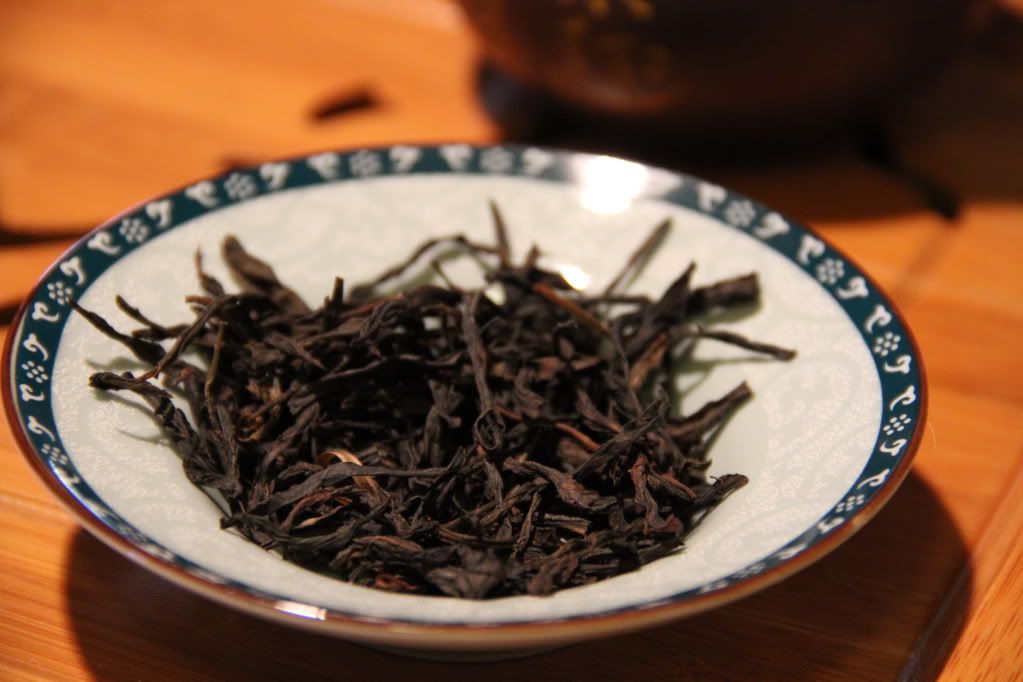
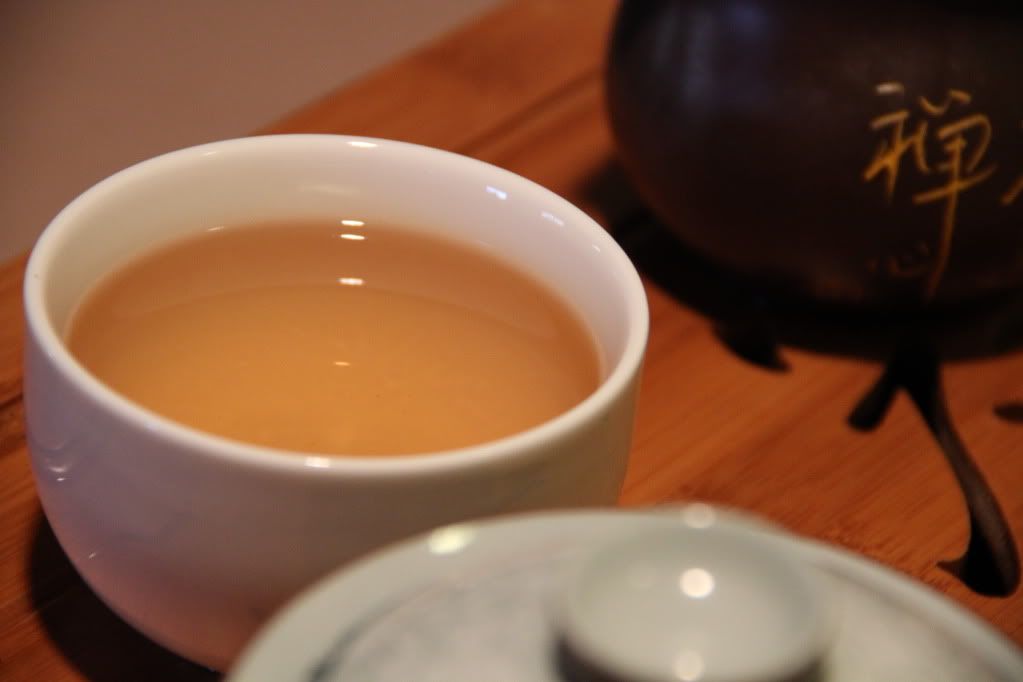
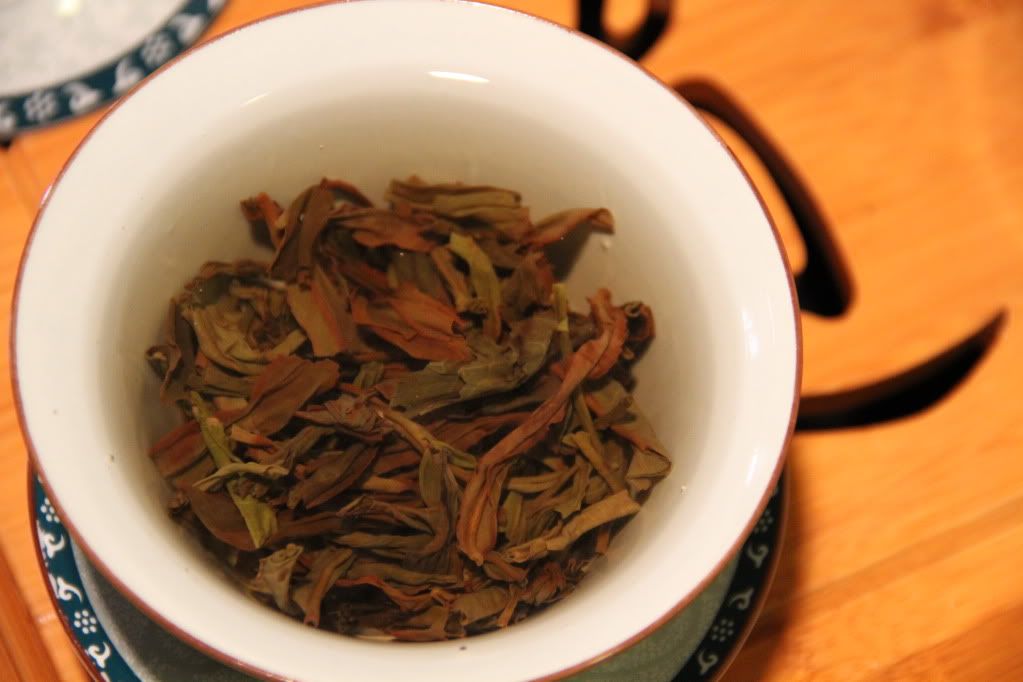
This is a wonderful tea, and as you can see from the infusing leaves, the quality is quite apparent. There are many different oxidation levels and I think that it is the blending of those differences that creates the unique characteristics of this tea.
Even though my descriptions may have made this sound like fairly complex tea, it really is not. The flavors are very up front and honest. I did not have to dig to hard to sense the qualities of this tea.

Once again, thank you to the fine folks at Bird Pick for this experience.